Sacramento Infill Program 2026
Calculate your estimated monthly installment for affordable housing development & infill projects.
🏢 Your Development Estimate
Sacramento County’s Infill Program is designed to make development in existing communities easier by addressing policy, infrastructure, cost, and process barriers that can make infill projects difficult to complete.
For 2026, the program is especially relevant to developers, affordable housing organizations, property owners, and communities looking at underused commercial corridors and already-developed areas. Sacramento County’s current approach combines the broader Infill Program with related housing incentives, development-fee programs, infrastructure planning, and affordable-housing initiatives.
One important distinction is worth making at the beginning: the Infill Program is a broader development strategy, while programs such as the Development Impact Fee Offset Program (IFOP) and fee-deferral programs provide specific financial assistance or timing benefits for qualifying projects. Understanding how these pieces fit together can help developers identify the right pathway for a proposed project.
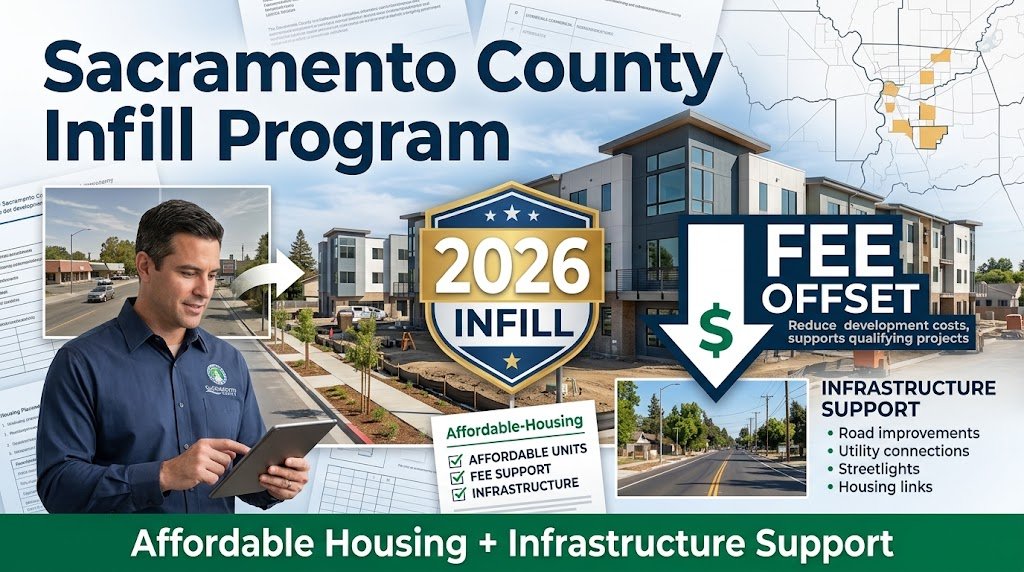
What Is the Sacramento County Infill Program?
The Sacramento County Infill Program focuses on removing barriers that can slow or discourage development within existing urbanized areas and commercial corridors.
Rather than relying only on expansion into new growth areas, infill development makes use of land and infrastructure that already exist within established communities.
Sacramento County adopted an updated Infill Program in August 2024 after identifying major obstacles affecting infill projects. The update established an implementation framework containing 13 actions addressing seven identified barriers to infill development.
The County says the program is intended to help create more livable and walkable neighborhoods while attracting investment and reinvestment into commercial corridors.
Why Infill Development Matters
Infill projects can potentially:
- Reuse underdeveloped or previously developed land
- Support housing production closer to existing services
- Revitalize aging commercial corridors
- Make better use of existing public infrastructure
- Reduce pressure for outward expansion
- Encourage mixed-use and walkable development
- Support additional investment in established communities
The approach is particularly important when the cost and complexity of developing vacant land on the urban edge are compared with the challenges of redeveloping established areas.
Sacramento County Infill Program 2026: What Has Changed?
The County’s infill strategy is not a single grant or payment program. Instead, it is a collection of policy and implementation actions intended to make infill development more practical.
The County began updating its earlier 2008 Infill Program after receiving a Local Early Action Planning grant in 2021. The updated effort incorporated stakeholder input, development-review recommendations, and direction from the Board of Supervisors.
The current program emphasizes practical implementation in commercial corridors and focuses on barriers such as:
- Infrastructure limitations
- High development costs
- Difficult land acquisition and assembly
- Application and development fees
- Existing development patterns
- Development-review challenges
- Conditions that can make infill less competitive than greenfield development
This matters because an infill project may face expenses that a conventional new-growth project does not encounter in the same way.
Affordable Housing and the Infill Strategy
Affordable housing is an important part of Sacramento County’s broader housing and infill efforts.
The County’s 2021–2029 Housing Element identifies programs intended to address housing needs across income groups. The County adopted the current Housing Element on March 8, 2022.
The County also operates an Affordable Housing Ordinance that applies to qualifying residential development in unincorporated Sacramento County.
Under the ordinance, developers may have different compliance options, including paying an affordability fee, dedicating land, or using an approved mechanism that contributes to affordable housing production.
As of March 27, 2026, Sacramento County lists the current affordability fee at $3.91 per habitable square foot of each market-rate housing unit, following a 3.24% annual adjustment.
This fee should not be confused with the separate development-impact-fee offset program discussed below.
Sacramento County Development Impact Fee Offset Program
One of the most significant affordable-housing developments connected to Sacramento County’s current housing strategy is the Three-Year Development Impact Fee Offset Pilot Program.
The program was adopted to reduce a financial barrier facing qualifying affordable housing projects.
The County originally established the pilot with a $5 million fund, with the possibility of additional resources from affordable-housing-related funds. The program was designed around qualifying projects providing housing for low-income residents, with an offset of up to $10,000 per affordable housing unit under the program structure.
2026 Expansion of Fee Offsets
In August 2026, Sacramento County announced an expansion of the program.
According to the County, four affordable housing projects totaling 435 units had already been approved for approximately $2.16 million in fee offsets. Approximately $2.84 million remained from the original $5 million fund at the time of the announcement.
The expansion allows eligible projects to receive offsets for development impact fees associated with three additional parks districts:
- Carmichael Recreation and Park District
- Mission Oaks Recreation and Park District
- The unincorporated portion of the Sunrise Recreation and Park District
The County explains that the arrangement does not reduce the funding received by those park districts. Instead, the County uses the existing affordable-housing fund allocated to the pilot to offset eligible park-district development impact fees for qualifying projects.
How Much Can an Eligible Project Receive?
The program can provide up to $10,000 per affordable housing unit, subject to program eligibility, available funding, applicable fees, and other requirements.
That means the program should not be interpreted as an automatic $10,000 payment to every housing project.
The actual benefit depends on whether a development qualifies and which eligible fees apply.
Fee Offsets vs. Fee Deferrals: What Is the Difference?
This is an important distinction for anyone researching Sacramento County development incentives.
Fee Offset
A fee offset reduces eligible development-impact-fee costs for qualifying projects under the applicable program.
Sacramento County’s affordable-housing Impact Fee Offset Program was specifically created to address development costs that can make low-income housing projects financially difficult to build.
Fee Deferral
A fee deferral changes when certain fees must be paid rather than permanently eliminating the obligation.
Sacramento County has historically operated development-fee deferral programs that allow developers or homebuilders to pay part of applicable development impact fees at building permit issuance and delay the remainder according to the applicable deferral period.
In June 2026, the Board of Supervisors expanded the County’s Residential Development Impact Fee Deferral Program to all residential projects, including eligible mixed-use developments containing housing. The stated purpose was to reduce upfront development costs and improve access to capital during construction.
In simple terms:
| Program type | Main benefit |
|---|---|
| Fee offset | Reduces eligible costs |
| Fee deferral | Delays payment of eligible costs |
| Affordable Housing Ordinance | Provides affordable-housing compliance mechanisms |
| Infill Program | Addresses broader barriers to infill development |
Infrastructure Support for Infill Projects
Infrastructure is one of the biggest challenges associated with redevelopment.
An established commercial corridor may already have roads, utilities, drainage systems, sidewalks, and other public facilities, but that does not necessarily mean the existing infrastructure can accommodate a substantially denser project.
Sacramento County’s infill planning materials identify infrastructure upgrades as an important potential component of facilitating redevelopment.
The County’s supporting infill documentation has discussed potential activities such as water, sewer, and other necessary infrastructure improvements, along with mobility-related infrastructure and other improvements that can facilitate infill development.
This is particularly relevant for older commercial corridors where infrastructure was designed for an earlier development pattern.
What Infrastructure Can Affect an Infill Project?
Depending on the location and project type, developers may need to evaluate issues involving:
- Water capacity
- Sewer capacity
- Stormwater and drainage
- Roads and transportation
- Sidewalks and pedestrian connections
- Transit access
- Utility infrastructure
- Parking and circulation
- Emergency access
- Electric vehicle infrastructure
- Other public facilities
The exact requirements vary by project and location. Developers should therefore avoid assuming that an infill designation automatically provides infrastructure funding or eliminates required improvements.
Commercial Corridors Are a Major Focus
Sacramento County’s current Infill Program places significant attention on commercial corridors.
These areas can contain older shopping centers, underused commercial parcels, vacant properties, or buildings that no longer match current housing and community needs.
Redevelopment can potentially transform these locations into:
- Apartments
- Mixed-use developments
- Affordable housing
- Neighborhood-serving commercial space
- Walkable residential areas
- New community-oriented destinations
The County describes its goal as removing policy barriers that hinder development in commercial corridors while attracting resources and reinvestment into those areas.
Can Infill Development Include Affordable and Market-Rate Housing?
Yes.
The County’s infill strategy is broader than affordable housing alone. Its 2024 program update described residential, commercial, and mixed-use development as potential outcomes of the program.
At the same time, Sacramento County has separate housing programs intended to encourage affordable housing production.
This creates an important opportunity for developers to examine multiple programs together rather than treating the Infill Program as an isolated incentive.
A project might need to consider:
- Infill eligibility or location considerations
- Zoning and land-use requirements
- Affordable Housing Ordinance compliance
- Development impact fees
- Fee-deferral opportunities
- Affordable-housing fee offsets
- Infrastructure requirements
- Environmental review
- Building and development approvals
The availability of one program does not automatically guarantee eligibility for another.
Sacramento County Affordable Housing Incentives
The County also identifies an Affordable Housing Incentive Program associated with California’s State Density Bonus Law.
Depending on the project and qualifying conditions, incentives can include increased density, development-standard incentives or concessions, and waivers of certain development standards.
This can be especially important when a proposed affordable housing development is constrained by the amount of housing that can otherwise be built on a site.
However, eligibility is project-specific and depends on applicable state and local requirements.
How the Different Programs Fit Together
For developers, the biggest advantage of understanding Sacramento County’s 2026 housing landscape is recognizing that several tools address different parts of the development equation.
The Infill Program focuses on removing broader barriers.
The Affordable Housing Ordinance establishes affordable-housing compliance mechanisms for applicable residential development.
The Impact Fee Offset Program can reduce certain eligible development impact fees for qualifying affordable housing projects.
Fee-deferral programs can reduce upfront financial pressure by changing the timing of eligible fee payments.
Affordable Housing Incentive Program provisions can provide qualifying projects with density-related and development-standard incentives.
Together, these policies can potentially improve the feasibility of projects that might otherwise struggle with land, infrastructure, regulatory, and financing costs.
Who May Benefit From the Sacramento County Infill Program?
The program can be particularly relevant to:
- Affordable housing developers
- Multifamily housing developers
- Mixed-use developers
- Property owners in commercial corridors
- Community development organizations
- Housing nonprofits
- Investors evaluating redevelopment opportunities
- Local planning professionals
- Architects and design teams
- Developers considering adaptive reuse
- Organizations pursuing housing production on underutilized sites
Eligibility and available incentives depend on the specific property, jurisdiction, project type, funding source, and applicable program rules.
How to Evaluate an Infill Development Opportunity
Before purchasing land or finalizing a development concept, a developer should perform a detailed feasibility review.
1. Confirm the Property Location
Determine whether the site is in an area targeted by Sacramento County’s infill policies or another applicable planning initiative.
2. Review Existing Zoning
Check the current zoning designation, allowed uses, density, height, setbacks, parking requirements, and other development standards.
3. Examine Infrastructure Capacity
Determine whether existing water, sewer, transportation, drainage, and utility systems can support the proposed development.
4. Estimate Development Fees
Use Sacramento County’s applicable fee information and project-specific calculations rather than relying on generic estimates.
The County provides a fee schedule and fee calculator for development-related applications.
5. Investigate Affordable Housing Programs
If the project includes affordable units, examine the Affordable Housing Ordinance, fee-deferral opportunities, fee-offset programs, and other applicable incentives.
6. Review Financing Feasibility
Calculate the effect of land costs, construction expenses, financing, fees, infrastructure work, affordable rents, and expected revenue.
7. Seek Project-Specific Guidance
Because requirements can differ substantially between properties, early coordination with Sacramento County planning and relevant agencies can reduce the risk of relying on an incentive that does not apply to the proposed project.
What Developers Should Know About Development Impact Fees
Development impact fees help fund public facilities needed to serve growth.
Sacramento County identifies development impact fees as funding sources for facilities and improvements involving areas such as roads, transit, sewer, drainage, water supply, libraries, and parks.
These fees serve an important infrastructure purpose, but they can also increase the upfront cost of housing construction.
That tension explains why Sacramento County has developed tools such as fee deferrals and the affordable-housing fee-offset pilot.
The objective is not simply to remove infrastructure funding. Instead, certain programs attempt to address the financial timing or affordability challenges associated with development while maintaining investment in public facilities.
Is the Sacramento County Infill Program a Direct Grant?
Not necessarily.
This is one of the most important points for people searching for “Sacramento County Infill Program funding.”
The Infill Program is primarily a policy and implementation framework for reducing barriers to development.
Separate programs may provide financial benefits, fee offsets, fee deferrals, or other incentives to qualifying projects.
Therefore, a property owner should not assume that being located in an infill area automatically results in a cash grant.
The specific financial assistance available depends on the individual project and the program for which it qualifies.
Does the Infill Program Automatically Waive All Development Fees?
No.
Sacramento County operates several fee-related programs, but eligibility is not universal.
Some programs may defer payments, while others may offset eligible costs for qualifying affordable housing projects.
Developers should identify each applicable fee and determine whether a specific waiver, offset, credit, or deferral is available.
This distinction can make a significant difference when preparing a project budget.
2026 Affordable Housing Fee Information
Sacramento County’s Affordable Housing Ordinance page states that the affordability fee increased to $3.91 per habitable square foot of each housing unit effective March 27, 2026.
Because fees can change through annual adjustments or policy updates, developers should verify the current figure before using it in a financial model.
A published number should be treated as a starting point rather than a substitute for an official project-specific determination.
Sacramento County Infill Program and Housing Production
The larger objective behind these policies is to make it easier to produce housing in locations where development can make productive use of existing communities and infrastructure.
Sacramento County’s housing and infill efforts recognize that simply identifying land for housing is not enough.
A project must also be financially feasible, properly zoned, adequately served by infrastructure, and capable of moving through the development process.
Reducing unnecessary barriers can therefore have an effect beyond a single development application.
Important 2026 Takeaway for Property Owners
Property owners holding underused commercial or previously developed land should not automatically assume that redevelopment is financially impractical.
An infill feasibility review can reveal opportunities involving:
- Increased housing density
- Mixed-use development
- Affordable housing incentives
- Fee deferrals
- Potential qualifying fee offsets
- Existing infrastructure
- Commercial corridor redevelopment
- State density bonus opportunities
The right combination depends heavily on the property’s location and proposed use.
Frequently Asked Questions
What is the Sacramento County Infill Program?
It is Sacramento County’s strategy for reducing policy, infrastructure, cost, and process barriers that can make development in established communities and commercial corridors difficult. The current program update was adopted in 2024.
What is the Sacramento County Impact Fee Offset Program?
It is a three-year pilot designed to offset certain development impact fees for qualifying affordable housing projects. The program can provide up to $10,000 per affordable housing unit, subject to its requirements and available funding.
How much funding remains in the affordable housing fee-offset program?
Sacramento County reported in August 2026 that four projects totaling 435 units had received approximately $2.16 million in offsets, leaving approximately $2.84 million from the original $5 million fund at that time.
Does the fee-offset program cover every development fee?
No. The offset applies to eligible development impact fees under the program’s rules. Developers must determine which fees and projects qualify.
What is the 2026 Sacramento County affordable housing fee?
Sacramento County lists the affordability fee at $3.91 per habitable square foot of each housing unit effective March 27, 2026.
Is the affordable housing fee the same as the infill fee offset?
No. They are separate concepts. The Affordable Housing Ordinance establishes an affordability fee and other compliance options, while the Impact Fee Offset Program provides offsets for qualifying development impact fees associated with eligible affordable housing projects.
Can residential projects defer development fees?
Sacramento County operates development-fee deferral programs, and in June 2026 the County expanded its Residential Development Impact Fee Deferral Program to all residential projects, including eligible mixed-use developments containing housing.
Does infill development automatically receive infrastructure funding?
No. Infrastructure support depends on the project, location, applicable program, available resources, and required improvements. Sacramento County’s infill planning documents identify infrastructure upgrades as one potential tool for facilitating infill development.
Can affordable housing projects receive density incentives?
Qualifying projects may be able to use the County’s Affordable Housing Incentive Program and applicable State Density Bonus Law provisions. Potential incentives can include increased density and certain development-standard incentives or waivers, subject to eligibility requirements.
Bottom Line: What Sacramento County Infill Program Means in 2026
The Sacramento County Infill Program 2026 is best understood as a broader effort to make redevelopment within established communities more practical.
Its importance goes beyond a single financial incentive.
The County is addressing infill through a combination of policy changes, commercial-corridor planning, housing programs, development-fee tools, infrastructure considerations, and development-process improvements.
For affordable housing developers, the Impact Fee Offset Program is particularly significant because qualifying projects can receive offsets for eligible development impact fees, with the program structured around a potential maximum of $10,000 per affordable housing unit.
For residential and mixed-use developers, the expanded fee-deferral program can help reduce the amount of capital required upfront by changing when qualifying fees are paid.
For property owners and investors, the broader lesson is equally important: an underused site in an established Sacramento County community may deserve a detailed infill feasibility analysis before its development potential is dismissed.
Because program rules, funding availability, fees, and project requirements can change, applicants should verify current requirements with Sacramento County and the relevant agencies before making financial or development decisions.
Quick 2026 Reference
Program: Sacramento County Infill Program
Primary purpose: Reduce barriers to infill development
Key focus: Commercial corridors, housing, reinvestment, infrastructure and development processes
Affordable housing fee offset: Up to $10,000 per qualifying affordable housing unit under the applicable pilot program
Original fee-offset fund: $5 million
Reported remaining original fund in August 2026: Approximately $2.84 million
2026 Affordable Housing Ordinance fee: $3.91 per habitable square foot, effective March 27, 2026
Residential fee deferral: Expanded in June 2026 to all residential projects, including eligible mixed-use developments with housing
Current Housing Element: 2021–2029
Information in this article reflects Sacramento County information available as of September 1, 2026. Program eligibility, funding availability, fees, and development requirements may change. Always verify current requirements before submitting an application or making a development decision.